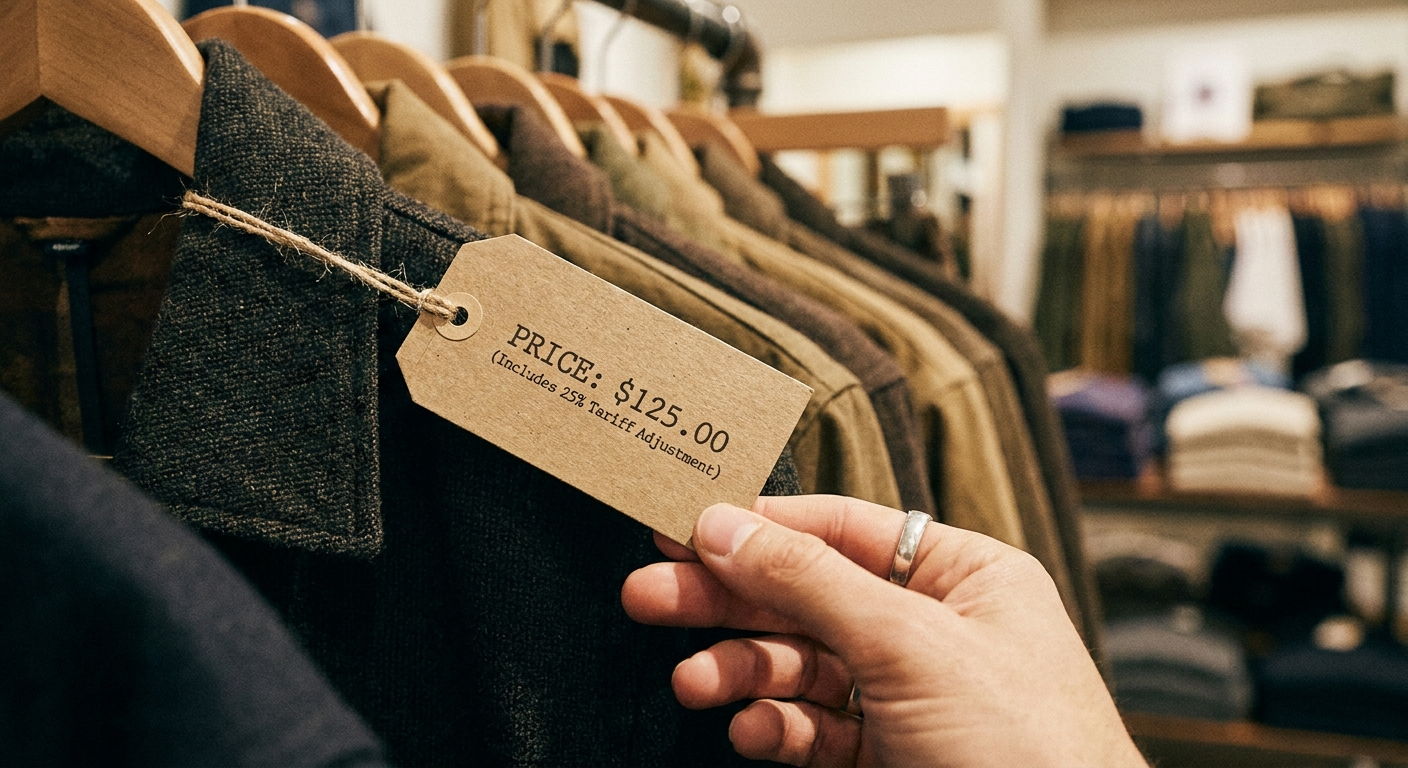
How New Tariffs Will Impact Retail Pricing: A Brand's Guide to Margin Protection
Community Attire · 5 min read
The April 2025 reciprocal tariff announcement sent shockwaves through apparel manufacturing. Vietnam facing 46% duties. China at 145%. Bangladesh, Pakistan, Indonesia, and India all in the 26–37% range. But the headline tariff rate is only half the story. What matters for your business is how those duties flow through your supply chain and hit your retail price.
This guide walks through concrete pricing scenarios and shows you exactly where the margin pressure hits. We'll show you the math, then walk through four core strategies to protect profitability.
The Tariff Math: From Factory to Retail
Let's start with a concrete example. You're sourcing a basic cotton t-shirt from Vietnam at an FOB price of $10. Under the old 7.5% tariff regime, your landed cost (FOB + duty) was:
| Cost Component | Old Tariff (7.5%) | New Tariff (46%) | Increase |
|---|---|---|---|
| FOB Price | $10.00 | $10.00 | — |
| Tariff Duty | $0.75 | $4.60 | +$3.85 |
| Landed Cost | $10.75 | $14.60 | +35.8% |
Now let's see what that means for your retail price. Assume you're a mid-market brand with a standard 60% markup from landed cost to wholesale (this covers labor, overhead, and profit). Your wholesale price was $17.20. Retail (at 50% markup) was $34.40.
| Pricing Layer | Old Model | New Model (Full Pass-Through) | Retail Change |
|---|---|---|---|
| Landed Cost | $10.75 | $14.60 | +35.8% |
| Wholesale (60% markup) | $17.20 | $23.36 | +35.8% |
| Retail (50% markup) | $34.40 | $46.72 | +35.8% |
A $34 t-shirt just became a $47 t-shirt. That's a 35.8% price increase on the shelf. For many categories, that's the difference between volume and margin collapse. Consumers who balked at $34 will definitely balk at $47.
Four Strategies to Protect Margins
You have options. None of them are painless, but each has a case. Here's what brands are actually doing in April 2025.
Strategy 1: Absorb the Cost (Short-Term Only)
Some brands are holding retail prices and eating the tariff cost. This preserves volume and customer relationships. But it's unsustainable. In our example, absorbing the full $3.85 tariff increase means your 60% markup drops from 60% to 19% on that unit. Cash flow suffers immediately. This only works if you believe tariffs will reverse within 12 months. Most supply chain strategists aren't betting on that.
Strategy 2: Pass It Through Entirely
Full pass-through (what we showed above) preserves your margin percentage but signals a 35%+ price shock to consumers. This works if: your brand has pricing power (premium luxury), your product is essential (uniforms, workwear), or you target price-insensitive channels (high-end retail, government procurement). Mass retail and DTC brands rarely have this luxury.
Strategy 3: Split the Hit
Most sophisticated brands are splitting the burden: absorb part of the cost, pass some through. Example: you increase retail by 15–20% instead of 36%, but you also tighten margins slightly. Your new retail price is $39–$41 instead of $47. Volume impact is reduced, but margin still contracts. This requires improving operational efficiency elsewhere (smaller order batches, consolidation with fewer factories, negotiated price freezes with suppliers).
Strategy 4: Reformulate to Lower Cost
The most proactive move: reduce the FOB price itself. Cheaper materials, simpler construction, different trim suppliers. If you can cut FOB from $10 to $8.50, the tariff math changes. New landed cost: $8.50 × 1.46 = $12.41 instead of $14.60. You've recovered $2.19 of the $3.85 hit. The risk: customers notice the quality reduction. This only works if product changes are subtle—simpler seams, lighter-weight (but still quality) fabric, fewer color options.
The Real Margin Pressure: Which Brands Feel It Most?
Not all categories are equally exposed. High-margin, price-conscious categories (fast fashion, basic basics, discount retail) have the thinnest ability to absorb. If your current gross margin is 40%, a 35% cost increase eats 14 points of margin. That's catastrophic.
Brands with lower volume but higher per-unit margins (athletic performance wear, technical/specialty apparel, premium basics) have more flexibility. They can pass through a larger portion of the cost without killing demand.
What This Means for Your Manufacturing Strategy
The pricing squeeze forces a single decision: where to manufacture. Vietnam's 46% tariff is brutal. China's 145% is worse. But Indonesia (32%), Bangladesh (37%), Pakistan (29%), and India (26%) offer meaningful relief.
If your product can be made in India at FOB parity with Vietnam, you just saved 20 points of tariff. That translates to $2 on a $10 unit—nearly 30% of your tariff exposure recovered. That's the difference between a viable retail price and a dead product.
This is why diversification—splitting production across multiple countries—is no longer a nice-to-have. It's operational necessity.
Need Help Protecting Your Margins?
Community Attire manufactures in six countries with tariff exposure ranging from 26% to 46%. We help brands choose the right sourcing strategy to maximize margins while protecting quality. Let's talk about your specific category, volume, and margin targets.
Get a Tariff Strategy Consultation