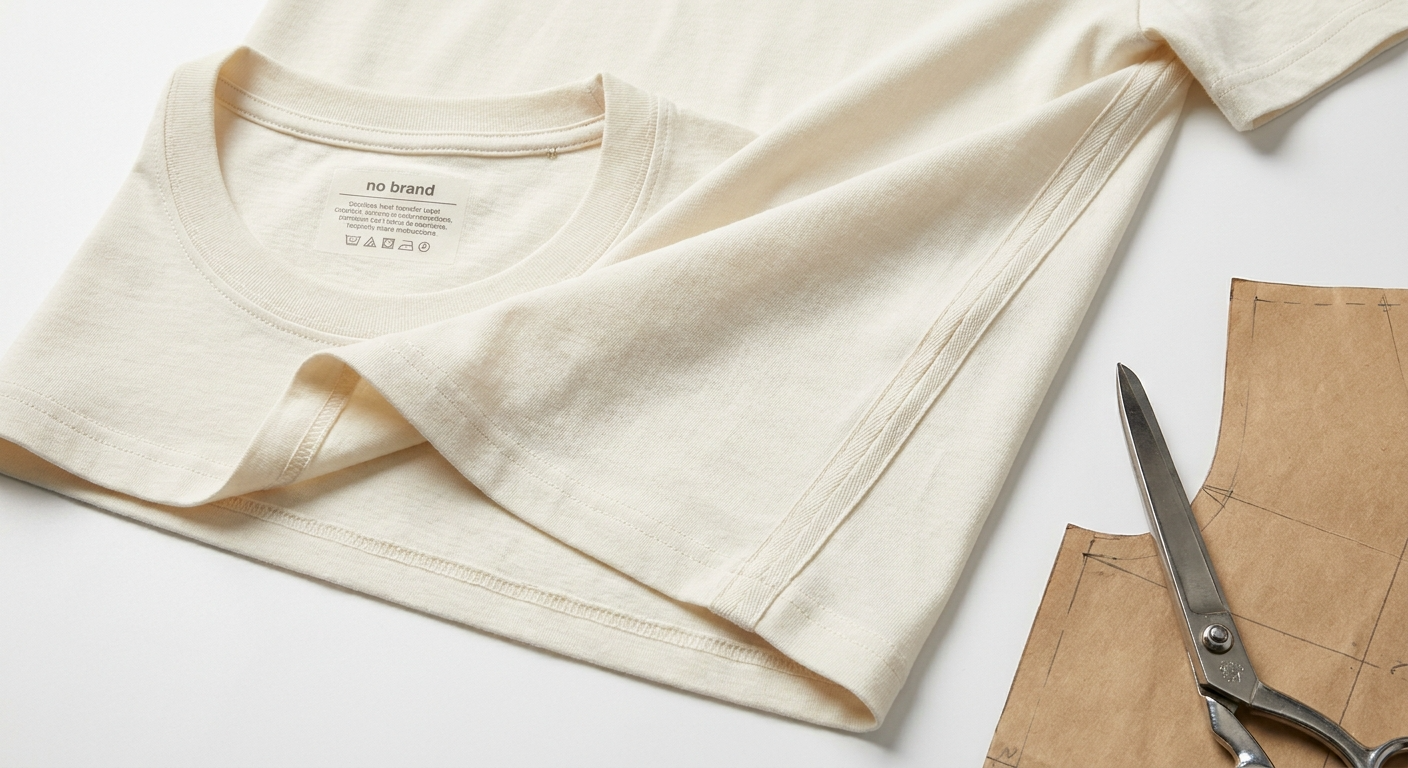
Understanding Garment Construction: A Beginner's Guide for New Brand Owners
Community Attire · 8 min read
You've designed a t-shirt. You show it to a manufacturer and they say: "You need a 2-thread safety stitch on the side seams, flat-lock on the shoulder, and a blind stitch for the hem." You nod like you understand. You don't.
Apparel manufacturing is a specialized craft. The difference between a $5 t-shirt and a $50 t-shirt isn't always fabric—it's construction. How seams are joined, how hems are finished, how thread tension is set, how pressing is executed. This guide explains what actually matters.
How Seams Work: The Foundation of Garment Quality
A seam is where two fabric pieces join. The quality of that join determines the garment's integrity, durability, and appearance. Not all seams are created equal.
1. Single-Needle Seam (Simple Lock Stitch)
The simplest seam: two fabric pieces pressed together, sewn with one thread, one needle, one row of stitching. Example: the center front button placket on a dress shirt. Cost: lowest. Appearance: clean, professional if well-executed. Durability: good for non-stress seams.
You'll see single-needle seams on premium garments because they look refined. But they're weak under stress. Don't use single-needle on side seams of a t-shirt that will be pulled and stretched.
2. Safety Stitch (2-Thread or 3-Thread)
The workhorse of apparel manufacturing. Two pieces of fabric are joined with a lock stitch, then the seam allowance is finished (trimmed and bound or covered) with a separate thread. If one stitch breaks, the seam doesn't fully unravel because the finishing stitches hold it.
Used on: side seams, armholes, necklines—anywhere the garment experiences stress. A 2-thread safety stitch costs $0.08–0.12 per seam. A 3-thread safety stitch (stronger finishing) costs $0.12–0.16. Standard practice on most apparel.
3. Flat-Lock Seam (Specialty Stitching)
Premium construction where the seam allowance is folded flat and stitched, creating a flat, comfortable seam with no bulk. Used on performance wear, underwear, and high-end knits where you want zero irritation. Cost: $0.25–0.40 per seam. You pay for the extra labor and specialty equipment.
A brand owner's question: is flat-lock necessary for your product? If you're selling basics at $15 wholesale, probably not. If you're selling premium activewear at $40+, yes. It's a cost-benefit decision.
Hems, Cuffs, and Finishing Details
How the edges of a garment are finished is where quality becomes visible. A sloppy hem makes an otherwise decent garment look cheap.
Blind Stitch Hem (Premium)
The garment edge is folded, and a needle catches only one thread of the top layer, creating a stitch that's invisible from outside. Used on dress pants, premium t-shirts, quality dresses. Cost: $0.15–0.25 per garment depending on hem length. Appearance: professional, refined. Durability: excellent if done correctly.
Single-Needle Rolled Hem (Very Premium)
The edge is rolled tightly and stitched with a single needle creating a tiny, flat hem. Common on silk scarves, fine dresses, premium basics. This is hand-finished on luxury garments but can be mechanized. Cost: $0.20–0.40. Appearance: extremely refined.
Serged/Overedged Hem (Economy)
The raw edge is wrapped and stitched with a serger machine, creating a finished edge. Used on basics, casual wear, activewear. Cost: $0.05–0.08. Appearance: functional, adequate. Durability: good for non-stress areas.
Rib Binding (Knit Collars & Cuffs)
A stretch rib fabric is sewn around necklines and armholes, creating a professional, durable finish that recovers after washing. The binding is typically 1.5–2 inches wide and folded around the raw edge. Quality depends on binding weight and stitch consistency. Cost: $0.12–0.25 per garment for materials and labor.
Pressing and Finishing: The Details That Define Quality
A garment can be perfectly sewn but ruined by poor pressing. Conversely, excellent pressing can make adequate construction look acceptable. Pressing is where apparel transitions from "raw" to "finished."
Seam Pressing (Critical)
After sewing, seams are pressed open or to one side (depending on garment design) to lie flat. This prevents puckering and ensures seams sit precisely. Temperature matters: cotton can handle 400°F+, synthetics require 280–320°F. Too hot and you melt the fabric. Too cool and the seam doesn't set.
Hem Pressing
Hems are pressed flat so they sit invisibly. A poorly pressed hem is immediately obvious. This step alone can cost $0.10–0.20 per garment depending on hem length and complexity.
Full-Garment Pressing (Finishing Press)
The entire garment is steamed and pressed using large machines (heat plates, steam guns) to remove wrinkles, set the shape, and achieve a polished appearance. Labor-intensive but essential for premium apparel. Budget $0.25–0.50 per garment for full pressing.
Thread Quality and Stitch Specifications
You specify a stitch, and a factory asks: "What thread weight? What tension? What stitch length?" These details matter.
Thread Weight
Measured in ply (number of strands twisted together). 40-weight (3-ply) is standard. 30-weight (thicker) is more visible and durable. 50-weight (thinner) is delicate. A spec sheet should specify thread weight. Example: "All seams: 40-weight polyester thread, color-matched to fabric."
Stitch Length
Measured in stitches per inch (SPI). 10–12 SPI is standard for most apparel. Tight stitching (14+ SPI) is stronger but risks puckering knits. Loose stitching (8 SPI) is faster but weaker. Specify stitch length in your construction specs.
Thread Tension
Balanced tension means the stitch lock is centered in the fabric. Over-tension causes puckering. Under-tension creates loose stitches that can unravel. Factories have tension standards, but fabric variations (stretchy knits vs. wovens) require adjustment. This is where pre-production sampling becomes critical.
Quality Standards and Inspection
How do you know if a garment is well-made? Inspection is the answer. But inspection isn't binary (good/bad). It's graduated.
AQL (Acceptable Quality Level)
Industry standard for inspection. You sample a statistically valid number of garments (based on total lot size) and assess them against quality criteria. AQL 2.5 means 2.5% of sampled units can have minor defects. AQL 1.0 means 1%. AQL 0.65 is very strict. Your spec sheet should specify your AQL standard.
Common Quality Defects
- Seam slippage: Stitches separate from fabric due to weak seams or insufficient thread tension.
- Puckering: Wrinkled seams caused by over-tension or fabric characteristics.
- Skipped stitches: Missing stitches in a seam due to needle issues or tension problems.
- Twisted seams: Seams spiral instead of running straight.
- Poor hem: Hems not flat, uneven, or separating.
- Thread knots: Visible knots in stitching, indicating poor thread joining.
Writing a Construction Specification
When you work with a manufacturer, you provide a spec sheet. This should detail exactly how your garment is constructed. Here's what to include:
Example Spec: Premium T-Shirt
Seams: All seams use 40-weight polyester thread, 10–12 SPI, safety stitch construction
Shoulder seams: 2-thread safety stitch, pressed open
Side seams: 2-thread safety stitch, pressed to back
Neckline: 1.5" rib binding, 1x1 rib, color-matched, flat-lock stitch attachment
Armholes: 2-thread safety stitch, armhole binding with coverstitch topstitch
Sleeve cuff: 1" rib binding, 1x1 rib, safety stitch attachment
Hem: Serged edge, single-needle stitch, 1" hem allowance, pressed
Labels: Woven main label sewn inside back neckline, care label sewn inside right side seam
Finishing: Full garment pressed, steamed to remove wrinkles
QC Standard: AQL 1.0, inspect all seams, hems, and labels per attached checklist
A detailed spec sheet eliminates ambiguity. The factory knows exactly what you want and can quote accordingly. Without specs, factories make assumptions that may not match your expectations.
Pre-Production Sampling: The Truth Test
Before committing to 50,000 units, you make 5–10 sample garments on the actual production equipment. This is your opportunity to verify that your specs translate to actual garments.
During pre-production sampling, you:
- Verify seam quality: Are they consistent? Do they pucker? Are they strong?
- Test fit: Do the garments match your fit spec?
- Evaluate finishing: Are hems flat? Are labels secure? Is pressing adequate?
- Check color accuracy: Does the dyed fabric match your approval swatch?
- Assess comfort: How does the garment feel in hand?
Samples reveal construction reality. A factory might confirm your specs verbally, but samples show whether they can actually execute them. Smart brands consider pre-production sampling non-negotiable.
Get Your Construction Specifications Right
Community Attire helps new brand owners develop detailed construction specifications, manage pre-production sampling, and execute quality control. We translate your design vision into production-ready specifications that manufacturers can execute consistently.
Get Construction Guidance