The PP Sample: Why Pre-Production Approval Is the Single Most Important Gate in Your Apparel Program
Community Attire · 9 min read
Every apparel program has a moment where the outcome is decided long before the first shipping container is sealed. It is almost never the design review, the tech pack sign-off, or the salesman sample. It is the pre-production (PP) sample approval.
If you are a retailer, DTC brand, or institutional buyer running a private label program, the PP gate is the last chance to catch anything you do not want showing up at scale. What you sign off on becomes what 10,000 — or 1,000,000 — units will look like. There are no take-backs once the cutter starts spreading fabric.
What is a PP sample, exactly?
A pre-production sample is a sample made on the actual production line, with production-intent fabric, trims, threads, and construction — before any volume cutting begins. It is the sample that is supposed to look exactly like the unit that comes out of the production run.
That is what distinguishes a PP sample from the earlier samples:
- Proto / fit sample: early, made on development machines, used to iterate fit and construction.
- SMS / salesman sample: for internal review, sales, photo shoots. Often made with substitute trims.
- PP sample: made on the production line, with the exact bill of materials and construction that will be replicated in bulk.
You can have a beautiful SMS and still fail in production — because SMS units are handled with a care no factory can afford to replicate across 200,000 pieces. The PP sample is the only one produced under production conditions. That is why it is the gate.
Why programs fail at the PP gate
The pattern we see, repeatedly, is not that PP samples reveal catastrophic defects. It is that they reveal dozens of small deltas from the tech pack — shade, seam allowance, label placement, trim vendor, fabric hand — and buyers sign off anyway because they are behind schedule and the sample is “close enough.”
“Close enough” at the PP stage is a promise you will pay for in returns, markdowns, and re-works. We have audited enough downstream failures to have a strong view on this: the cost of a one-week PP hold is almost always less than the cost of discovering the same problem in finished goods at the port.
What to actually inspect at PP
A disciplined PP review covers four layers. Most programs cover two.
1. Materials and trims
- Fabric: mill name, composition, weight (GSM), shade vs. your approved lab dip, hand feel, performance test certificates on file.
- Trims: zippers, buttons, interlining, labels, hangtags — exact vendor, exact spec, no substitutions.
- Thread: composition, color match, tex weight per seam type.
2. Construction
- Seam types against the tech pack (flat-fell vs. overlock vs. coverstitch).
- Stitch density (SPI) within the spec band.
- Reinforcement points (bartacks at stress points, bartack count).
- Finishing detail: hem construction, topstitch placement, facing anchoring.
3. Measurements and grading
- Measurement spec vs. sample, at every point of measure, against tolerance.
- Grading across the size run — spot-check the smallest and largest sizes, not just the base size.
- Fit on a live model when the program warrants it (technical workwear, uniform, performance categories).
4. Labeling, packaging, and compliance
- Care labels (content, country of origin, RN number, care symbols).
- Hangtag and barcode placement per retailer spec.
- Polybag and carton markings if the retailer is DC-scanning.
- Compliance testing results on file (CPSIA, Prop 65, Cal Prop 65, REACH — whatever applies to the category and destination).
If any of these four layers is not physically present at the PP review, the gate is not closed. That is the discipline.
Build the gate into the calendar
On our private label programs, PP approval is a scheduled calendar date, not an aspiration. Miss it, and production moves without you. That sounds harsh but it is actually the kindest version of the truth: the alternative is that you approve something you did not properly inspect because the cut-in date is already gone.
A reasonable PP calendar rule of thumb for an apparel program:
- PP sample ready: 2–3 weeks before cut-in.
- Buyer inspection window: 3–5 business days.
- Corrections and re-PP (if needed): 5–7 business days.
- Hard sign-off: at least 10 business days before cut-in.
If your program is routinely approving PPs three days before cut-in, the gate is not actually doing any work.
Who should sign off?
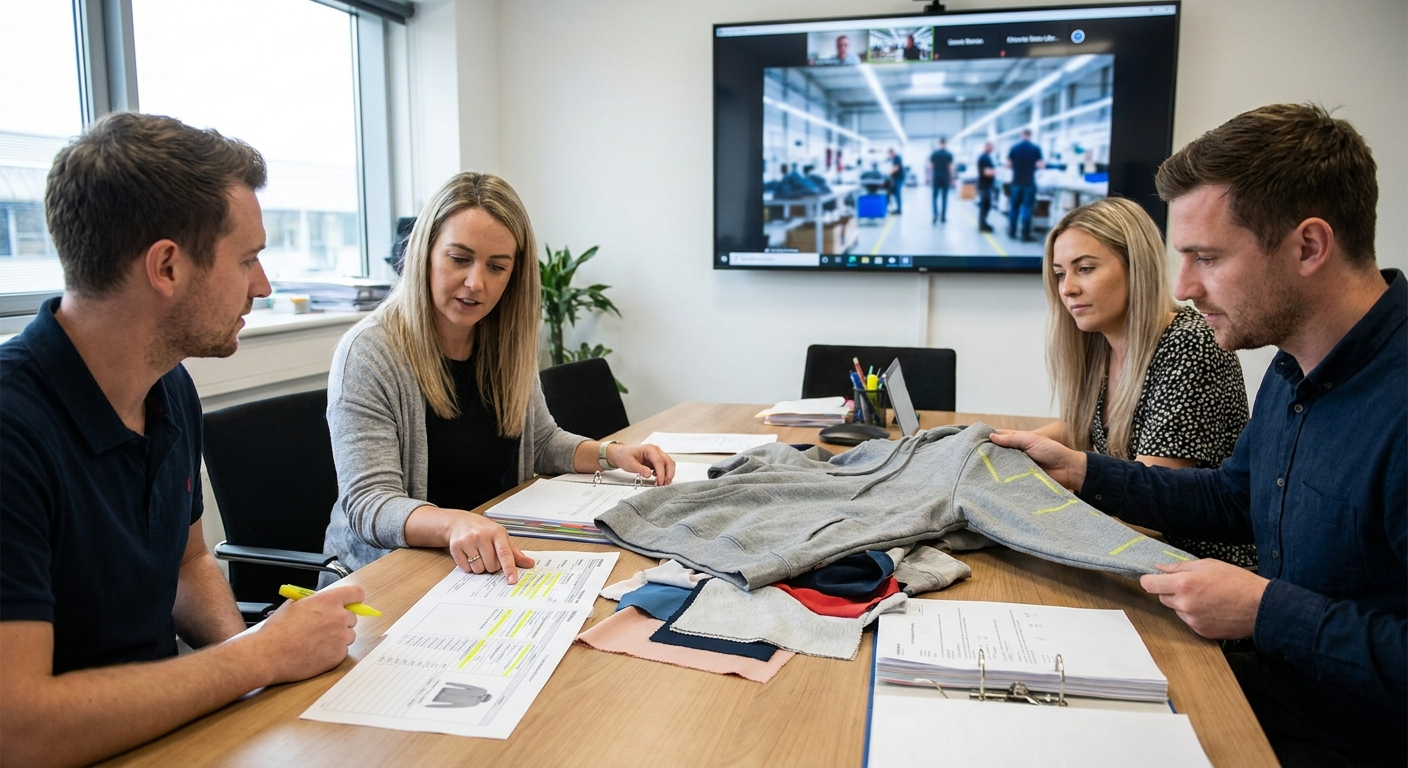
Two people, at minimum. A technical person who owns construction and measurement (tech designer, production lead, or QA lead). And a merchandising or brand person who owns shade, trim, and finish. On federal and institutional programs, add a compliance reviewer who signs off specifically on the documentation package.
A single sign-off buried in a product manager's inbox is not a gate. It is paperwork.
The bottom line
The single cheapest thing you can do to protect an apparel program is run a disciplined PP gate. It catches the problems that would otherwise become 8-week returns conversations, markdowns, or compliance audits.
That is what we mean when we say manufacturing is not a commodity. A run-of-the-mill sourcing agent will send you pictures of a PP sample and wait for an email reply. A real partner blocks the calendar, shows up with a tech designer, measures against the spec, and tells you what is actually different from what you approved — even when you are both tired and behind.
Running a program that needs a real PP gate?
We run PP reviews on every program we manage. On enterprise and federal work we add third-party QC at the factory before PP sign-off. Tell us what you are building.
Start a Quote